Saturday, December 1, 2012

Language Learning Service Verbling Launches Google Hangouts-Powered Classes, Adds Support For 9 New Tongues

Language Learning Service Verbling Launches Google Hangouts-Powered Classes, Adds Support For 9 New Tongues: Screen shot 2012-11-30 at 4.01.57 PM
Learning a new language can be tedious and frustrating. Thankfully, a new generation of startups are leveraging advances in mobile and web technologies to make that process more enjoyable and rewarding. Today, companies like Livemocha, PlaySay, Voxy, italki, MindSnacks and Duolingo provide increasingly viable alternatives to traditional language-learning software — the Rosetta Stones of the world.
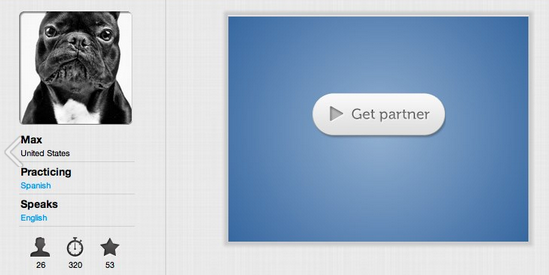
Another recent entrant into the space is Y Combinator grad Verbling, a venture-backed startup that wants to help turn language learners into polyglots by using video chat to connect them with real, live native speakers. Unlike the text-focused and algorithm-based Duolingo, Verbling wants to help users reach fluency and avoid the drop-out bug by creating a frictionless, in-browser live video chat experience that encourages immersion — albeit a virtual one.
After joining, the startup automatically pairs people that want to learn Spanish and are fluent in English, for example, with the opposite — those who are fluent in Spanish and want to learn English. It’s immersion via reciprocity. Users are matched by their experience levels and are encouraged to switch back and forth between languages (by an accompanying timer), with the system suggesting various prompts and targets along the way.
Since launching earlier this year, Verbling has focused exclusively on English and Spanish, but today the company is adding support for nine new languages, including Italian, French, German, Mandarin, Japanese, Hebrew, Portuguese, Arabic, and Russian, bringing the total to eleven. Founder Mikael Bernstein told us that these have been the most-requested languages from its users and, really, they represent the most-commonly spoken languages in the world.
Its new support for 11 languages puts the startup in good stead compared to Duolingo, Voxy and MindSnacks and puts it on par with the site that it probably most closely resembles — Busuu. A number of sites offer some kind of tool for connecting with native speakers, including courses and lessons on top of that. Bernstein believes Verbling has an advantage in this regard because its been laser-focused on its novice-to-expert matching and one-to-one video model.
The co-founder tells us that users are now participating in over 50,000 practice sessions per month and that sessions saw 317 percent month-over-month growth in November, which he expects will compound with the launch of its new language support. On tap of that, with sessions increasing, Verbling is also launching its own classes.
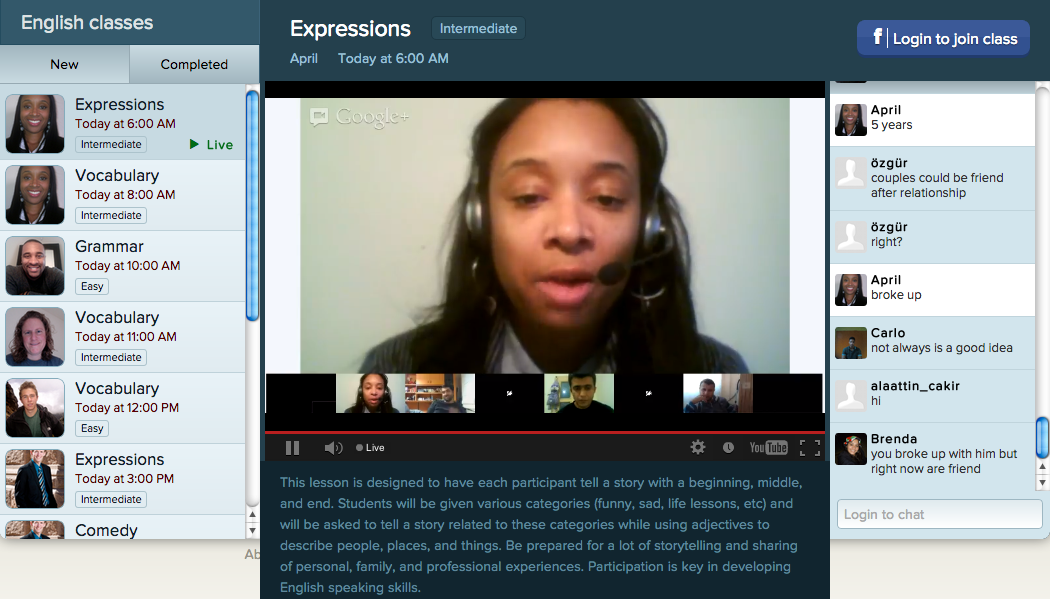
But it’s doing so by sticking to its video-chat roots, as “Verbling Classes” offer nine language students the ability to join Google Hangout-powered classes led by an official, TEFL-certified Verbling teacher. Bernstein says that, they were initially skeptical of using Hangouts, but after Google reached out to propose the solution, they considered it more seriously as a valid way to replicate a classroom setting. Something he says that can provide a virtual classroom experience that’s more fun and conversation-based and one that could become a future monetization vehicle.

For its main one-to-one video chat experience, Verbling tries to improve stickiness by allowing users to stay in touch with a chat mate if they enjoyed the conversation and found it productive. Learning a new language is definitely aided by adding a little constancy and familiarity, so being able to send a friend request via the platform, message each other (or just do a voice call if video seems awkward) is a great way to encourage users to build working professional relationships and pick up where they left off.
At first, the startup will only be hosting its Google Hangout language classes in English, which will be limited to nine-per-class but will be hosted on a range of subjects. Nine will get to directly participate, but even if you don’t make it, you can still listen in and actively participate. Going forward, Bernstein says that the startup wants to be able to allow students to pay a small fee to guarantee their spot in one of its classes.
Going forward, Verbling will be focused on building out this portion of the site and will be raising an additional round of funding to support this growth. The startup $1 million from DFJ, Learn Capital, Start Fund, Inspovation Ventures, SV Angel, Meck Investments, Ace & Company and others, back in January. The co-fouder also tells us that Verbling recently added Gustav Rydstedt as its new CTO, who was formerly the lead engineer at Blizzard on Diablo 3 and Peter Thiel’s 20-under-20 finalist, Brandon Paton.


Friday, November 30, 2012

Next Issue grows iPad library with addition of eight new magazine titles

Next Issue grows iPad library with addition of eight new magazine titles:
Next Issue grows iPad magazine library with addition of eight new titles
Next Issue -- the service unofficially billed as the Netflix of digital magazines -- has just announced an expansion of its catalog, adding eight additional titles to its tablet-based offering. This recent inclusion of big names brings the company's impressive library to a total of 80 even, letting iPad users now peruse the likes of New York Magazine, Food & Wine and Men's Fitness, just to name a few. Pricing for both Unlimited subscription tiers remains unchanged, with $10/mo still netting users access to 73 monthly and bi-weekly titles, while the more premium $15/mo service opens up the entire archive. As of now, these new additions won't work on Android slates, but the company promises "work is underway" to make them available across the board. Hit up the break to check out the official release.
Continue reading Next Issue grows iPad library with addition of eight new magazine titles
Filed under:
Comments

Raspberry Pi's $25 Model A enters production, could be in tinkerers' projects early next year

Raspberry Pi's $25 Model A enters production, could be in tinkerers' projects early next year:
Raspberry Pi's $25 Model A enters production, could be in tinkerer's projects early next year
Raspberry Pi's Model B computer will be no stranger to regular readers. We've seen it turn up in all sorts of projects, and generally stretched in various directions. If you were holding out for the cheaper, lower specced Model A however, your time is near. A recent post on the official Raspberry Pi site confirms that the first Model A samples are rolling off the production line. The main differences? Whereas Model B has two USB ports and 512 MB of RAM plus Ethernet, Model A sports only the one port, has half the RAM, and no Ethernet connection, making it more power economical as well as $10 cheaper. Price likely isn't the issue here, but if you were after the even more stripped back version, it's estimated they'll be ready to purchase online early next year.
Filed under:
Comments
Source: Raspberry Pi

Distro Issue 68: PC game designers and the quest for compatibility

Distro Issue 68: PC game designers and the quest for compatibility:
Distro Issue 68: PC game designers and the quest for compatibility
Well friends, the week's end brings with it an issue of our tablet mag that's hot off the digital presses. PC gaming nabs the cover story this time out as we take a look at the task of insuring compatibility across a set of devices that adds customized models constantly. If full-length gadget reviews are what you're after, we put the Lenovo ThinkPad Twist, Kindle Fire HD 8.9 4G LTE and Nintendo Wii U through their paces. Will.i.am's latest venture hits Hands-On, Oakley's high-tech eyewear occupies Eyes-On and Weekly Stat tracks holidays on Instagram. Visit your preferred reading repository to grab a copy before settling in for some weekend R&R.
Distro Issue 68 PDF
Distro in the iTunes App Store
Distro in the Google Play Store
Distro APK (for sideloading)
Like Distro on Facebook
Follow Distro on Twitter

Filed under: , ,
Comments
Source: iTunes, Google Play

Tuesday, November 27, 2012

Sharp ships its first phone with an IGZO display on November 29th, ushers in a low-power LCD era

Sharp ships its first phone with an IGZO display on November 29th, ushers in a low-power LCD era:
Sharp Aquos Phone Zeta SH-02E
The gray clouds of Sharp's gloomy earnings are about to get a silver lining: NTT DoCoMo is at last launching Sharp's new flagship phone, the breathlessly worded Aquos Phone Zeta SH-02E, on November 29th. When it arrives, the SH-02E will be its* first smartphone to carry an IGZO-based display and show us just how well the high-brightness, low-energy invention fares in a 4.9-inch, 720p LCD. There's no known fixed pricing, although it's likely the Android 4.0 device will be sitting at the very top of its Japanese carrier's range through its Snapdragon S4 Pro, 16-megapixel camera and LTE data. Not fully convinced of IGZO's worth? Fujitsu's more conventional Arrows V F-04E is arriving a day earlier with a regular LCD and a Tegra 3, although we'd say that it's worth waiting the extra 24 hours to be a technology vanguard.
Update: While the SH-02E was the first phone announced with an IGZO LCD screen, it's been beaten to the market by ASUS' Padfone 2, which is also rocking the new technology.
Filed under: ,
Comments
Via: Impress Watch (translated)
Source: NTT DoCoMo (translated)